skip to main |
skip to sidebar
 William Ralph Blass, or should I say Bill Blass, epitomized classic American style. This gentleman peacock had an impeccable eye and it showed in his work, home and personal style.
 Mr. Blass would have been 87 years old this past Monday, but passed away in 2002 from throat cancer—which was probably accelerated from his lifelong smoking habit.
 In photographs, Mr. Blass is usually shot with his trademark cigarette (above: 1940's).
 This boy from Fort Wayne Indiana, whose father committed suicide when he was only five years old, went on to create a $700-million-a-year fashion empire (above at the office in the 1970's).
 Above: Smokin' in Indiana in the 1970's.
As a teenager, Bill Blass, was already selling his sketches of gowns to a New York manufacturer, and continued to design until his retirement in 1999.
 During the 1940’s, when he was in the army, he sketched what would become his Bill Blass logo (above).
 Above: Looking casually elegant in a turtleneck and denim jacket—Chessy Rayner and Mica Ertegun are in the background.
He was pals with, and dressed, many of America’s most stylish ladies including: Chessy Rayner, Mica Ertegun, Slim Keith, and Nan Kempner.
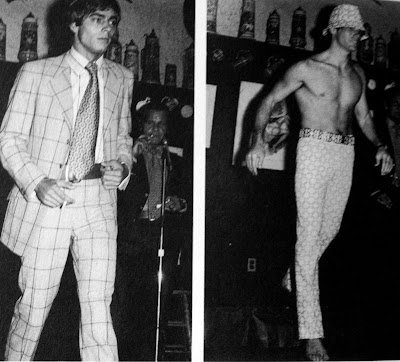 Above: A Blass menswear show from the 1970's—you can see Mr. Blass smoking in the background behind the model on the left.
His menswear line, like himself, was impeccably tailored and classic looking.
Because of the popularity of his men’s wear line, Bill Blass licensed his name to Revlon in the late 60’s-early 70’s. They created a Bill Blass men’s fragrance line that included bronzer, deodorant, soap, aftershave, and something called Men’s "Other" Deodorant—for the crotch!
 Bill Blass even designed a Lincoln Continental (above), when he partnered with the Ford Motor Company in the 1970's.
 When Mr. Blass was a newbie and starting out in Manhattan (above in the 40's), he looked sharp and had a chic apartment. He would buy the best quality things he could afford (Brooks Brothers clothing at the time), and later upgrade to more expensive and higher quality goods.
 Above: A Maidenform ad from Glamour magazine, 1961.
 Above: Bill Blass with Ralph Lifshitz (Ralph Lauren), c. 1970's.
 Whether he was wearing a denim jacket or a tuxedo, this gentleman peacock was always elegant and well groomed. He knew what looked good on him and stuck with it—clean and classic clothing.
 His homes were always chic and well appointed and he was a connoisseur of antiquities (above: his home at One Sutton Place in NYC).
 Above: A well dressed table and well dressed gentleman—Mr. Blass looking chic in an oversized gingham patterned shirt, navy blazer, pocket square, brown belt, chinos, and his trademark cigarette.
His was passionate about his homes and gardens, and liked entertaining guest.
 Mr. Blass bequeathed half of his $52 million estate, as well as several important sculptures to the Metropolitan museum of Art—including the piece above.
 To learn more about this talented fellow, click here for numerous books about Bill Blass. Mr. Peacock salutes this quintessential American style icon for his taste and continued influence and inspiration for new generations of peacocks. Thank you Bill Blass!
 (click image above to enlarge)The male peafowl, or peacock, has long been known for its display of its dramatic tail feathers. The brilliant hued feathers of the Indian Blue peacock have always been prized as decorative accents, and inspiration for artists and fashion designers.
Did know the brilliant colors of the peacock plumage are due to an optical interference phenomenon (Bragg reflection) based on (nearly) periodic nanostructures found in the barbules (fiber-like components) of the feathers, which produce the peacock's iridescent hues (which shimmer and change with viewing angle), depending upon the angle of light.
Here’s Mr.Peacock's wish list of “namesake” inspired goodies:
1) This hand-painted Syracuse pattern, by Haviland, reminds me of a stylized peacock feather. My mother inherited a set of Haviland dishes from her great-great grandmother, and the porcelain is sublime. It’s pricey, but a single dish could be very chic used to catch loose change and keys.
2) A gilded Indian peacock mirror would add an exotic touch to an entryway or room. It has a large mirror in the center, surrounded by small mirror discs inset in the “plumes.”
 3) This vintage 1960’s brass peacock table lamp would make a unique addition to your home. It has two bulbs, and rests on an ebony stained wood base.
4) A set of personalized note cards would make any gentleman peacock happy.
5) I found this peacock feather bric-a-brac at my favorite hardware store for around $3.75 a foot. The feathers are sandwiched (lightly glued in place) between a folded black grosgrain ribbon, and stitched closed along the seam. My photo doesn’t do this amazing bric-brac justice. It would be chic on the bottom of a lamp or window shade. Order some here, or check here.
6) Mr. Peacock loves these multi-colored leather boots. The sheen of colors reminds me of the iridescent hues of peacock plumage.
 7) Peacocks are pheasants, and this little hardcover book, Extraordinary Pheasants, has a plethora of this beautifully plumed group of birds. Buy one here for under a dollar.8) There are also many great fabrics inspired by the peacock. Mr. Peacock fancies this black and white pattern by Florence Broadhurst (at right).
This gentleman peacock's parents have a real live peacock that just showed up one day. Do you have a favorite peacock item?
In the summertime during my tween years, I would work for my father in his golf pro shop taking golf tee times, light book keeping, picking up golf balls on the driving range (ugh!), and keeping the golf carts clean and charged up. I would also sell golf accoutrements such as golf balls, golf gloves, golf shoes, golf clubs, and of course golf apparel...and do displays and merchandising in his shop.
 Above: My dad, on the far right, with fellow golf pros in the early 1960’s. My father was almost 6 feet tall, so the third gentleman has to be a giant.
My father disliked “loud” golf clothing—bright colors, busy patterns, and especially any cute patterns…ie whales. He sold Lacoste in his pro shop, but never wore anything himself with logos or branding. He didn’t want me wearing any “advertisements” either—that’s what he called any clothing with obvious logos and branding.
 Above: My dad, second from left, wearing tailor made trousers—sans belt loops in the late 1970's.As an adult, I understand where my dad was coming from about logos, and by choice I seldom wear anything with logos or obvious branding. However, I’ve always liked patterns (plaid, polka dots, paisley), colors, and even the occasional kitsch wardrobe item. I guess I’m rebelling against my father.
When Mr. Peacock first became acquainted with Loudmouth Golf clothing—I had to chuckle. It’s everything my father disliked...
 bright colors and...
 ...loud patterned pants!
 Above: Loudmouth also has shorts.
 Loudmouth offers various trouser cuts. The plaid and patchwork pants are 100% cotton, and the printed and striped pants are a summer poplin (97% cotton and 3% spandex).
 Above: Loudmouth even has patterned golf grips for a customized look on your golf clubs.
It’s nice to see an alternative to drab sportswear. Loudmouth clothing may not be everyone’s cup of tea, but Mr. Peacock thinks you can wear “loud” clothes and still look chic.
 Above: Alice Cooper wears Loudmouth, and has always been an avid golfer.
Wear one “loud” or patterned piece of clothing, and pair it with a solid color such as white, black, gray or navy—and wear it with confidence!
 Above: A peacock golfer in Loudmouth plaid pants.
The US Open Golf tournament championship is this week. My father played in this tournament in the 1960’s—wearing only black, gray or navy trousers, with white, powder blue, and pink polo shirts. Let’s see if anyone is wearing Loudmouth at the US Open.
 Above: A custom après golf jacket—you select the fabric...perfect for cocktails at the “19th hole.”
Do you wear any “loud” clothes—bright colors or patterns?
 Gio Ponti was one of the most prominent and prolific designers of the last century. For over six decades, this Italian gentleman designed buildings, furniture, ceramics, and textiles (above—in a cotton suit, with a bow tie).
 Above: Gio Ponti designed flatware.
  Above: Amethyst, turquoise and amber Gio Ponti glass bottles by Venini.In addition to being a trained architect, he also was a professor, artist, poet and magazine editor—always paying attention to the sublime details in his work. He was born in Milan on November 18, 1891, and died September 16, 1979.
 In 1950, Mr. Ponti, won the commission to design the 32-story Pirelli Tower (in collaboration with Pier Luigi Nervi and Arturo Danusso). The Pirelli Tower is his most iconic building, and the first skyscraper built in Milan.
 A lesser-known building, and the only Gio Ponti designed building in the United States (with Colorado architect James Sudler), is the Denver Art Museum (above)—completed in 1971. The Daniel Libeskand, Frederic C. Hamilton building, opened adjacent to the Gio Ponti building in 2006—as part of the Denver Art Museum expansion. Mr. Peacock isn't too keen on this new annex, neither is the New York Times. Another addition, the Duncan Pavilion, was added in 2006 as a link between the Gio Ponti and Daniel Libeskand buildings.
As a child, my mother would take me to the Denver Art Museum to stroll through the galleries and for lunch afterwards in the café. I always thought it looked like a modern castle, and I imagined I lived there.
 The entire surface is covered in 3-dimensional, steel gray tiles (above). This geometric shaped motif can be seen in other Gio Ponti works.
 Various shaped windows are scattered throughout the building (above). The interior spaces elegantly flowed and allowed the artwork to shine.
 The main entrance of the Ponti building had a large steel cylindrical shaped “tunnel.” I always imagined it was a slice of a submarine. It now has a tacky sign guiding visitors to the new main entrance, and was an unofficial bicycle parking area on my last pilmigrage. Sadly, the management of the Denver Art Museum doesn’t pay attention to details, like Mr. Ponti.
 Above: Mr. Ponti designed so many wonderful furniture pieces.
Mr. Ponti designed the iconic chair, Superleggera (Superlight—see below left), in 1957. It’s simplicity belies it’s genius design—that is both comfortable and elegant looking...and of course it's super light.
 Mr. Peacock has a half dozen Supperleggera chairs in aluminum with woven seats (above right). The sleek silhouette of the chair is ideal for apartments or small spaces. I can comfortably squeeze them all around my round table when I host dinner parties.
 Above: A pair of ceramic vessels designed by Mr. Ponti for Richard Ginori, c. 1924.In 1928, Mr. Ponti founded the design and architecture magazine Domus—published from its inception to 1999.
 He remained the editor, with a brief sojourn, until his death. You can buy a complete reproduction set of Domus (above).
 If Mr. Peacock wins the lottery, he would furnish his entire home in Gio Ponti (above and below—Ponti interiors).
 Until then, there are some great books documenting the talent and work of Gio Ponti.
 Above: A painting called, Gemini, by Gio Ponti.
 Above: A Gio Ponti designed, Reed & Barton, coffee service with rattan handle.
 Above: Gio Ponti ceramic tiles from 1964.
Gio Ponti is one of the most important design figures of the 20th century.This gentleman icon did it all—designing, writing, painting! Thank you Mr. Ponti!
Years ago, I had custom sepia style note cards (below) made as a gift for my grandmother (LaViolette) and aunt (Mildred). I used a photo of them smoking, when they were teenagers in the 1920's. They got a big kick out of these note cards, and my grandmother had so much fun mailing them to her friends. You can order your own custom cards here, or order some from your local print shop.
 Above photo, left to right: Aunt Mildred (about 13 years old), their friend Snookie, and my grandmother LaViolette (about 16 years old)—wearing their one-piece swimsuits and smoking cigarettes at the local "swimming hole."
Mildred and LaViolette, weren’t allowed to eat any processed foods growing up. Their father didn't allow them to even eat cornflakes cereal—only whole foods for longevity. It is still debatable who was the favorite of their parents, but I think Mildred was her dad’s favorite and LaViolette was her mother’s favorite. Their father thought both of his daughters should be able to do everything that the boys could do, and therefore taught them both how to drive their Model T Ford when they were only 10 years old. They were the only girls in their neck of the woods that knew how to drive, and later in their teens "chauffeured" all of their friends to parties—including the boys.  Above, left to right: LaViolette and Mildred in their 70's—they still liked to have a good time and go to parties...playfully showing some leg. The sisters in about 1915.
During prohibition, when they were teenagers, their father would let them get dressed up and attend parties at speakeasies in the big city. Mildred begged her dad to buy her fishnet stockings (and he would), and he also let her wear his fur coat when they went to parties (he was a fur trader).
 Above: The original photo of my grandmother, that I used for the note cards.
In their early teens, my grandmother cut her and her sister’s long hair (and their friends too) into a short style which they called “the mannish dip.”
 Above: My grandmother (on the left) looking boyish with her cropped hair and "wrapped bosom," with a friend—dressed up and going to some party in the 1920's.
My grandmother had large breasts which weren't very fashionable then, and would wrap herself in a towel to flatten her appearance when they got dressed up—while Mildred had a more fashionable svelte figure. They had many fun and care-free times as teenagers.
I'm attending my grandmother's memorial this week in celebration of her long life. I will be out of town until next week, but will be back next Wednesday!
Thank you everyone for the birthday greetings! And thank you to Mistress MJ at Infomaniac for the naughty birthday wishes last Friday. My favorite Aunt sent me a birthday card and a check (she has every year since I was born). This year she also included a tree dedication in my name through the Arbor Day Foundation. She's been "green" her entire life. You can buy a tree for someone here.
My mom took these photos at my birthday party when I turned 3 years old. I’m the chunky one in the short coveralls. We didn’t have big fancy, themed birthday parties as a child—just a few kids, ice cream and a homemade birthday cake on a sunny June day.
 At the party, my cousin Tracy, (I’m 2 months older) started to cry for some reason ...and ran to her mom, my Aunt Criss. I actually remember thinking, “Why are you crying Tracy, it’s my birthday party!?”
 One of my mom’s best friends, Nancy, brought her 2 sons, Ron and Tony. Ron was the oldest—maybe 6 or 7 years old. He didn’t really want play with us little kids.
 My mom said, “I want a picture of you and Ron…” So I grabbed his hand and my mom took the picture. Oh, to be 3 years old again...
My partner Jason made me a clever homemade birthday card (which he always does for me), and a wonderful dinner….and I received nice cards (and gifts) from my sisters too. Thanks everyone—I appreciate it!
What's your favorite birthday memory?

 William Ralph Blass, or should I say Bill Blass, epitomized classic American style. This gentleman peacock had an impeccable eye and it showed in his work, home and personal style.
 Mr. Blass would have been 87 years old this past Monday, but passed away in 2002 from throat cancer—which was probably accelerated from his lifelong smoking habit.
 In photographs, Mr. Blass is usually shot with his trademark cigarette (above: 1940's).
 This boy from Fort Wayne Indiana, whose father committed suicide when he was only five years old, went on to create a $700-million-a-year fashion empire (above at the office in the 1970's).
 Above: Smokin' in Indiana in the 1970's.
 During the 1940’s, when he was in the army, he sketched what would become his Bill Blass logo (above).
 Above: Looking casually elegant in a turtleneck and denim jacket—Chessy Rayner and Mica Ertegun are in the background.
 Above: A Blass menswear show from the 1970's—you can see Mr. Blass smoking in the background behind the model on the left.
 Bill Blass even designed a Lincoln Continental (above), when he partnered with the Ford Motor Company in the 1970's.
 When Mr. Blass was a newbie and starting out in Manhattan (above in the 40's), he looked sharp and had a chic apartment. He would buy the best quality things he could afford (Brooks Brothers clothing at the time), and later upgrade to more expensive and higher quality goods.
 Above: A Maidenform ad from Glamour magazine, 1961.
 Above: Bill Blass with Ralph Lifshitz (Ralph Lauren), c. 1970's.
 Whether he was wearing a denim jacket or a tuxedo, this gentleman peacock was always elegant and well groomed. He knew what looked good on him and stuck with it—clean and classic clothing.
 His homes were always chic and well appointed and he was a connoisseur of antiquities (above: his home at One Sutton Place in NYC).
 Above: A well dressed table and well dressed gentleman—Mr. Blass looking chic in an oversized gingham patterned shirt, navy blazer, pocket square, brown belt, chinos, and his trademark cigarette.
 Mr. Blass bequeathed half of his $52 million estate, as well as several important sculptures to the Metropolitan museum of Art—including the piece above.
 To learn more about this talented fellow, click here for numerous books about Bill Blass. Mr. Peacock salutes this quintessential American style icon for his taste and continued influence and inspiration for new generations of peacocks. Thank you Bill Blass!


